

Maybe We’ve Been Looking at Value Wrong
Why more services don’t always create more value.

MSPs struggle with value.
Defining it.
Explaining it.
And showing it.
We know our work matters, but we often fall back on the easiest way to prove it:
We show the client everything we do.
More tools.
More services.
More reports.
And more things included in the agreement.
But a bigger service list does not necessarily create more value.
Sometimes it just creates a bigger service list.
Which brings us back to the question we should have started with:
What is value?
Hi, I’m Rob.
I write about MSPs, productized services, and why trying to do everything usually creates a harder business instead of a better one.
Field notes and practical playbooks for building a calmer, more focused MSP business.
What is value?
The easy answer is that value is what improves for the client.
Their risk goes down.
Their systems become more reliable.
Their employees lose less time.
And their owner has fewer technology problems landing on their desk.
That is value.
But improvement is only part of the story.
Your internet provider may not improve your business every month.
But you still value the connection.
Your accountant may not find new ways to save you money every quarter.
But you still value having someone who understands your books and keeps things in order.
Your financial planner may not constantly change your investments.
Sometimes the value is knowing that someone is paying attention and will tell you when something needs to change.
These relationships are not valuable because they constantly produce something new.
They matter because they provide continuity, competence, and guidance as the world changes.
To me, that sounds a lot like a good MSP relationship.
The value may not just come from making things better every month.
It may also come from having someone help you navigate what comes next.
Three kinds of value
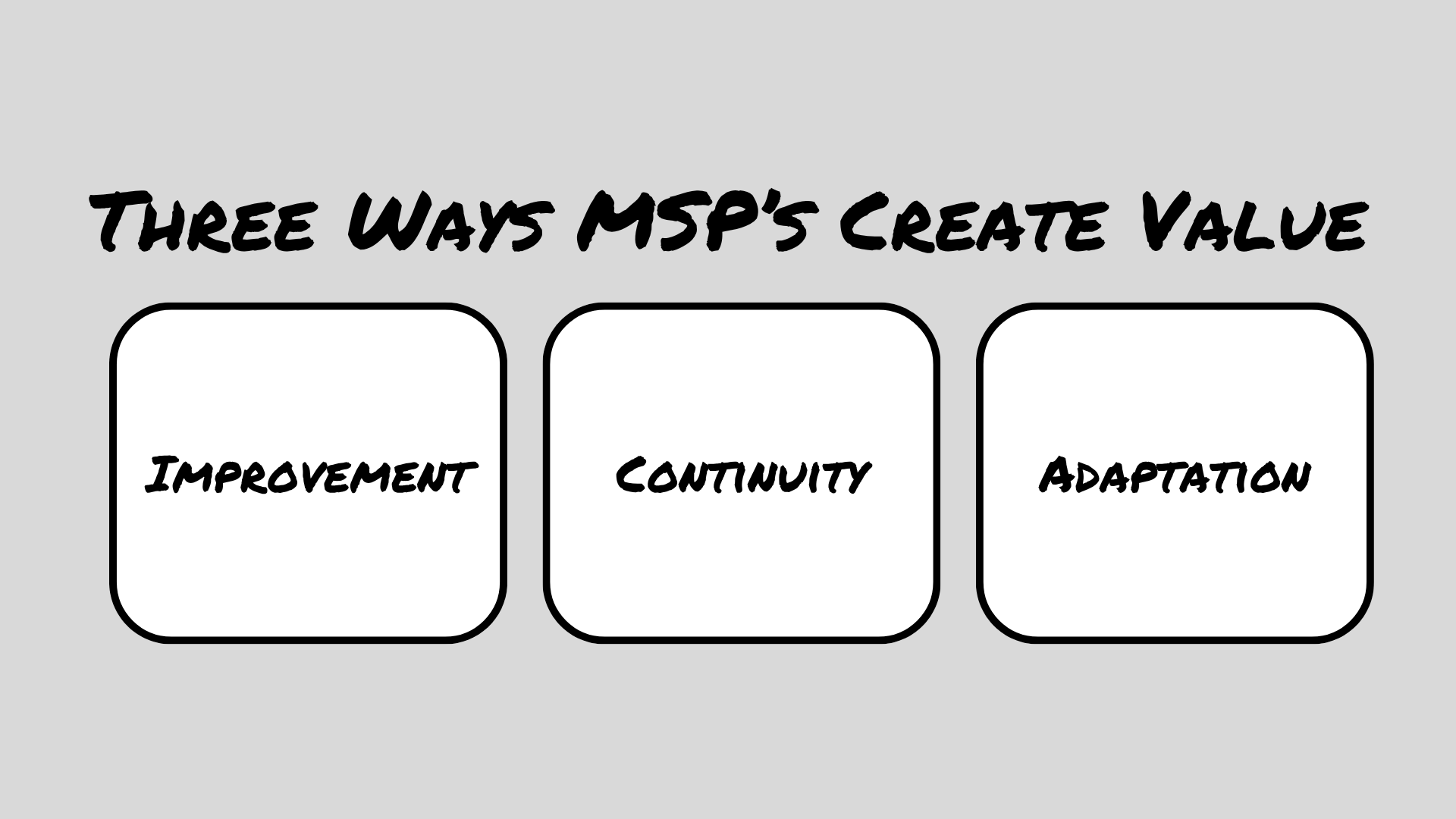
There are at least three kinds of value in an MSP relationship.
The first is improvement.
Something is better than before.
A recurring issue is fixed.
The environment is standardized.
Onboarding becomes easier.
Risk is reduced.
This is often where the relationship starts.
The client has a problem, and the MSP promises a better way.
The second is continuity.
Things keep working.
Users get support.
Backups run.
Systems stay available.
And someone is paying attention.
Continuity can look like the status quo.
But maintaining that status in a changing environment still takes work.
The third is adaptation.
The business evolves, and its technology must follow.
A new risk appears.
A vendor changes direction.
AI changes how people work and how businesses operate.
The MSP helps the client keep pace with change without adding unnecessary complexity.
Improvement gets things into a better place.
Continuity keeps them working.
And adaptation keeps them relevant.
All three matter.
The problem begins when the MSP only knows how to talk about one of them.
If we only talk about improvement, we create the expectation of endless improvements.
If we only talk about continuity, we sound like maintenance.
If we only talk about adaptation, the offer becomes vague and open-ended.
A well designed product balances all three.
More Stuff Is Not More Value
Most MSPs do not begin by designing a product.
They begin with something much broader:
“We help businesses with IT.”
Then the offer starts growing.
Add support.
Add monitoring.
Add backups.
Add security.
Add strategic reviews.
Add compliance.
Add another tool because the industry says every MSP needs it.
And then wrap the whole thing in language about being proactive, strategic, enterprise-grade, and a trusted partner.
Each addition may make sense.
But adding sensible things together does not automatically create a sensible product.
It just creates a pile.
A well-defined product starts with a different set of questions:
What problem are we trying to solve?
How will we solve it?
Why would a client want this?
What needs to be included for the product to work?
And what should be left out?
These questions force the MSP to make choices.
Without those choices, the offer keeps expanding.
Every new vendor pitch sounds like something the client should have.
Every industry trend becomes another service.
Every objection gets answered with another line item.
The offer gets bigger, but not better.
The client doesn’t need to understand every tool behind the service.
But they should understand what the product does for them.
Something like:
“Our technology works reliably. It stays up to date. When the business or the technology changes, our MSP helps us adjust.”
That’s not a slogan.
It is the product working as promised.
The client can say it because the product is simple enough to understand and consistent enough to experience.
Not because the MSP gave them a longer service list.
Not because the agreement contains more logos.
Not because someone added another dashboard or quarterly meeting.
More stuff is not more value.
A clear product solves a real problem, works as expected, and stays relevant over time.
A simple way to check your value
Set your service list aside for a minute.
Ask yourself four questions.
Why does this relationship matter to the client?
Do not list what you do.
What would be harder, riskier, or more chaotic without you?
What kind of value are you primarily providing?
Improvement, continuity, adaptation, or a clear mix of the three?
Can your clients explain the value without listing your tools?
If the only explanation is a stack of products and services, the offer may not be as clear as you think.
What have you added that no longer supports the promise?
A report nobody reads.
A meeting nobody values.
A tool that overlaps with another tool.
A service included because everyone else includes it.
More stuff is not more value.
Value is knowing why the relationship matters and what the client can expect.
It’s a service that keeps the business running and helps it adjust when the world changes.
That is a harder conversation than adding another line item.
But it is probably the conversation we should have been having all along.
Three Ways I Can Help You
1. Subscribe for Weekly Insights — Get clear, practical insights on the MSP business model delivered straight to your inbox.
2. MSP Strategic Advisory — Helping MSP owners simplify their business, sharpen their positioning, and build for the next stage of growth.
3. MSP Ecosystem Advisory — Advisory for vendors, founders, and investors building or investing in the MSP market.
💡 Enjoyed this article? Hit the 🩵 button and drop a comment with your thoughts.
👉 Follow me on LinkedIn for more insights and updates.